Use blockchain for accepted state
Dataset identity, feature geometry, version history, proof receipts, audit events, and snapshot checksums.
terminode.xyz
TermiNode is most useful when a normal application already has maps, users, and workflows, but needs a tamper-resistant layer for accepted geometry, history, proof receipts, and exportable evidence.
Where it fits
Most business apps should keep search, dashboards, private CRM data, and high-volume workflow state in normal infrastructure. TermiNode is the proof layer for spatial records that must survive review.
Dataset identity, feature geometry, version history, proof receipts, audit events, and snapshot checksums.
Role dashboards, private comments, notifications, billing records, and high-volume search can remain in existing databases.
GeoJSON, receipt JSON, and checksums let customers take evidence into procurement, dispute, audit, or partner systems.
Benefits
The value is operational: clearer provenance, reproducible evidence, safer bounded access, and a neutral source of proof for high-value spatial records.
Show who changed a record, what changed, and why the current geometry is accepted.
Compare versions and export proof receipts when a boundary, coverage zone, or claim area is questioned.
MCP tools let AI assistants inspect dataset, version, audit, and metrics context without write access.
Implementation pattern
Start with one record type and one proof need. The goal is not to move the entire product on-chain; it is to make the highest-trust spatial state independently inspectable.
Example 1
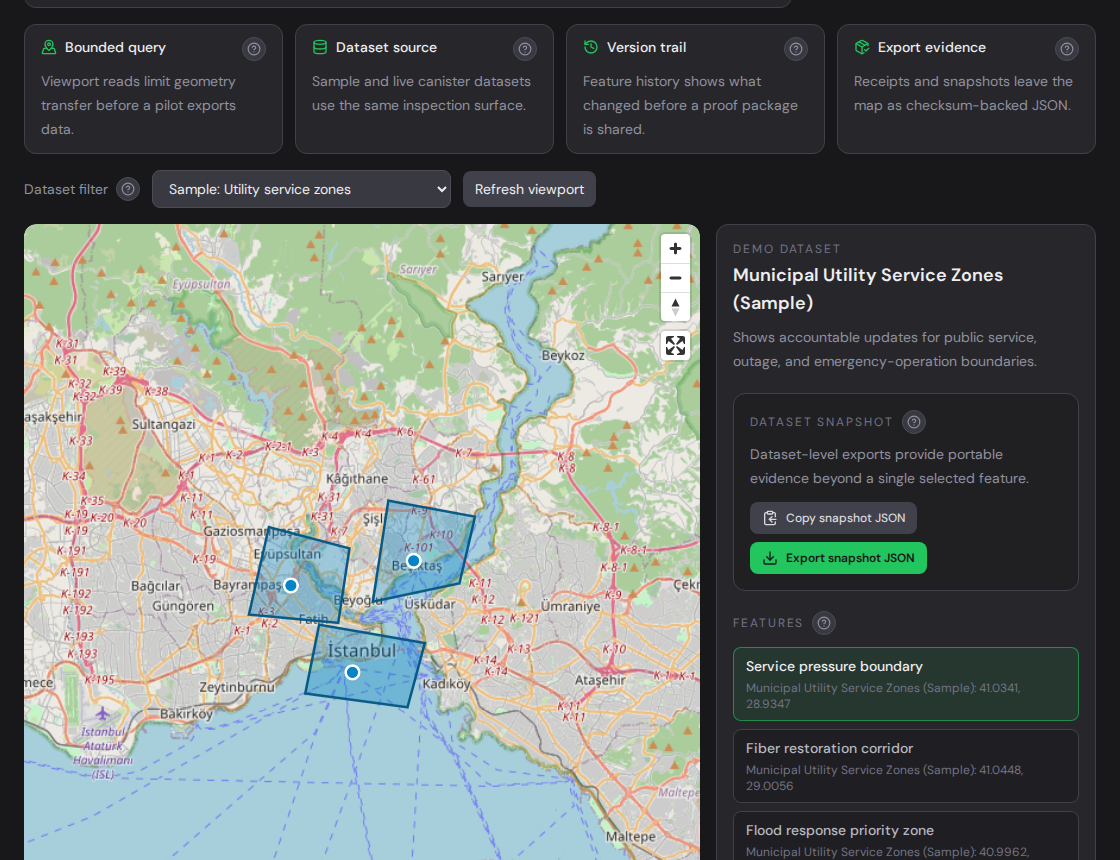
A municipality can keep its normal public portal, but anchor the accepted service-zone layer in TermiNode.
1. User opens a service-zone map in the city portal.
2. Portal asks TermiNode for bbox GeoJSON for the current viewport.
3. User selects a zone and portal fetches feature versions.
4. Portal links to terminode.io/#map for proof receipt and export evidence.
Example 2
A logistics system can use TermiNode to verify whether a route or delivery point intersects an approved compliance boundary.
Example 3
A claims or infrastructure review tool can keep private case handling in its own system and use TermiNode for the spatial proof package.
Do not overuse it
A good integration is selective. Avoid publishing personal data, secrets, private notes, unreviewed drafts, high-frequency telemetry, raw payment data, or anything that cannot safely become durable public or controlled public state.